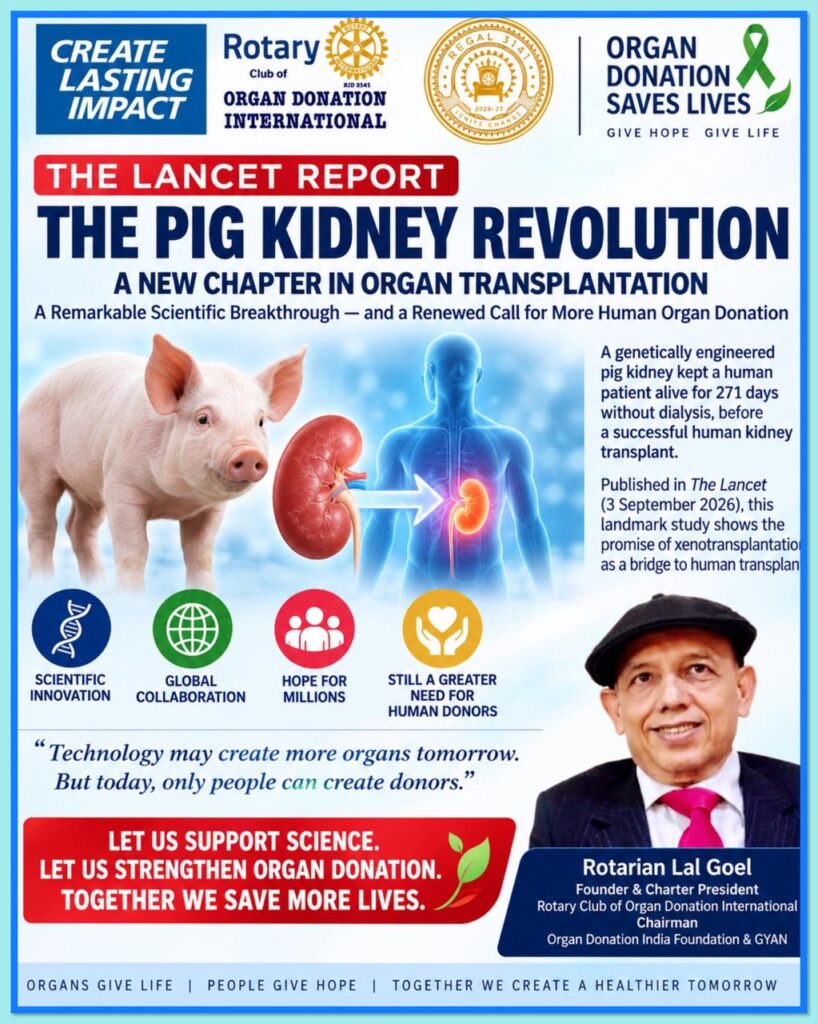
THE PIG KIDNEY REVOLUTIONA Landmark Breakthrough in Xenotransplantation
By Rotarian Lal Goel
Founder & Charter President
Rotary Club of Organ Donation International
Chairman
Organ Donation India Foundation & GYAN
A landmark first-in-human study published in The Lancet has brought xenotransplantation — the transplantation of animal organs into humans — closer to clinical reality.
Founded in 1823, The Lancet is one of the world’s oldest and most respected peer-reviewed medical journals, and its rigorous editorial standards lend particular weight to this study’s findings.
Researchers at Massachusetts General Brigham transplanted a genetically engineered pig kidney into a 66-year-old patient. The kidney functioned for 271 days without dialysis — the longest dialysis-free period reported after a pig-to-human kidney transplant. It eventually failed and was removed, and the patient later received a deceased-donor human kidney.
The significance lies not in readiness to replace human kidneys today, but in proof of concept: a bridge that can keep patients alive and off dialysis while they wait for a suitable human donor.
A GLOBAL SCIENTIFIC EFFORT
The field is advancing through international collaboration. eGenesis in the United States and PorMedTec in Japan are developing genetically engineered pigs for transplantation research — work that shows xenotransplantation moving from experimental science toward clinical and commercial application.
Substantial challenges remain: immune rejection, infection risk, long-term safety, regulation, ethics, animal welfare, and affordability. Considerable research lies ahead.
INDIA CANNOT AFFORD TO WAIT
In India, where demand for kidney transplantation far outstrips the supply of deceased-donor organs, xenotransplantation could eventually be transformative. India should build expertise now in transplant immunology, genetics, biotechnology, infectious-disease surveillance, and regulatory science, while pursuing international research collaboration.
But one message matters equally:
XENOTRANSPLANTATION MUST NOT REDUCE OUR COMMITMENT TO HUMAN ORGAN DONATION.
Human donation saves lives today. Xenotransplantation may expand the organ supply tomorrow. We need both.
AN OPPORTUNITY FOR ROTARY
This emerging technology is also an opportunity for Rotary International. Rotary’s historic role in global polio eradication proved that a humanitarian organisation can unite governments, scientists, healthcare professionals, communities, and donors around a single global health challenge.
The Rotary Club of Organ Donation International could propose — through Rotary District Governor 3141, to the Rotary International President — a global Rotary initiative to support awareness, collaboration, and responsible development of xenotransplantation.
If science ultimately produces genetically engineered pig kidneys capable of functioning reliably for five to ten years or longer, with replacement possible when needed, it could become a true game-changer in transplantation. Rotary need not conduct the science; its role can be to connect scientists, clinicians, institutions, and industry — keeping the humanitarian objective at the centre.
TOWARDS ORGAN ABUNDANCE
The future may draw on multiple sources of organs: deceased donors, living donors, genetically engineered animal organs, bioengineered organs, and regenerative medicine. The goal is not to choose between them.
THE GOAL IS SIMPLE: NO PATIENT SHOULD DIE BECAUSE A SUITABLE ORGAN IS UNAVAILABLE.
Donate organs today. Support science for tomorrow. Together, we can transform transplantation.