2025 Barclays Private Clients Hurun India Most Valuable Family Businesses List Released

by Prashant Kapadia/NHN
Mumbai, India | 12th August 2025: Barclays Private Clients and Hurun India released the 2025 Barclays Private Clients Hurun India Most Valuable Family Businesses List, ranking India’s most valuable family businesses. To be included on the list, a next-generation member from the founding family must be actively involved in managing the business or serving on its board. Value calculations are as of 30 June 2025.
Commenting on the launch, Nitin Singh, Head of Barclays Private Bank, Asia Pacific, said, “We are delighted to partner with Hurun India for the second edition of this list, which shines a spotlight on the scale and influence of India’s most valuable family businesses — many of whom are long-standing clients of Barclays Private Clients. This year’s findings reveal an unprecedented INR 130 lakh crore in wealth expected to transfer across generations over the next five years, and a record 71 families now operating dedicated family offices, underscoring the focus on structured wealth management. We also see a growing community of Global Indians at the helm, leading from outside the country while continuing to invest in and shape India’s economic story.”
“At Barclays Private Bank, we are privileged to work alongside these families as they navigate growth, complexity and intergenerational change. Our investment-led approach, backed by global connectivity and specialist expertise, helps clients preserve and grow their wealth, manage cross-border needs, and achieve ambitions that span both generations and geographies.”
“Beyond wealth creation, these families are building industries, creating employment, and contributing significantly to the nation’s tax base — with the top 300 generating INR 7,100 crore every single day last year. The addition of 100 new entrants to this year’s list is a powerful sign of India’s deepening entrepreneurial base and the role family businesses will continue to play in driving growth across sectors and regions,” he added.

Commenting on the launch, Anas Rahman Junaid, Founder and Chief Researcher, Hurun India said, “Indian family businesses are the heartbeat of our nation’s economy, embodying resilience, innovation, and a deep-rooted legacy of entrepreneurship. This year’s list expanded to 300 families, collectively worth USD 1.6 trillion (about INR 134 lakh crore) – more than the combined GDP of Turkey and Finland. Even the bar to enter the top 200 has surged – the cutoff valuation rose by 70% YoY. Their economic footprint is enormous: together they generated roughly INR 7,100 crore of value every single day last year, and nearly three-quarters of these businesses grew in value year-on-year,
underscoring their vitality in India’s growth story.”
“Private equity is no longer knocking on the doors of India’s family businesses — it’s firmly inside the boardroom. From billion-dollar stakes in icons like Haldiram’s to transformative healthcare investments in Meril, private equity is reshaping India’s family-run enterprises at every scale. In the past year alone, global investors such as Temasek, Bain Capital, ChrysCapital, Multiples — and sovereign wealth giants like ADIA with their USD 200 Mn investment in Meril —have partnered with promoters to unlock expansion,professionalise governance, and bridge succession transitions. It marks a new era where patient capital meets generational ambition.”
“The List highlights the sectoral heft of India’s family-run firms across manufacturing and beyond. Industrial products companies form the largest segment on the list with 48 entries, while the automobile and auto components sector
boasts the highest average valuation – about INR 52,320 Cr per company. Pharmaceuticals is another stronghold, with 25 leading family businesses averaging over INR 41,000 Cr each. This diversification – from factories and pharma to autos – underlines how family businesses drive India’s industrial prowess and enhance our global competitiveness and
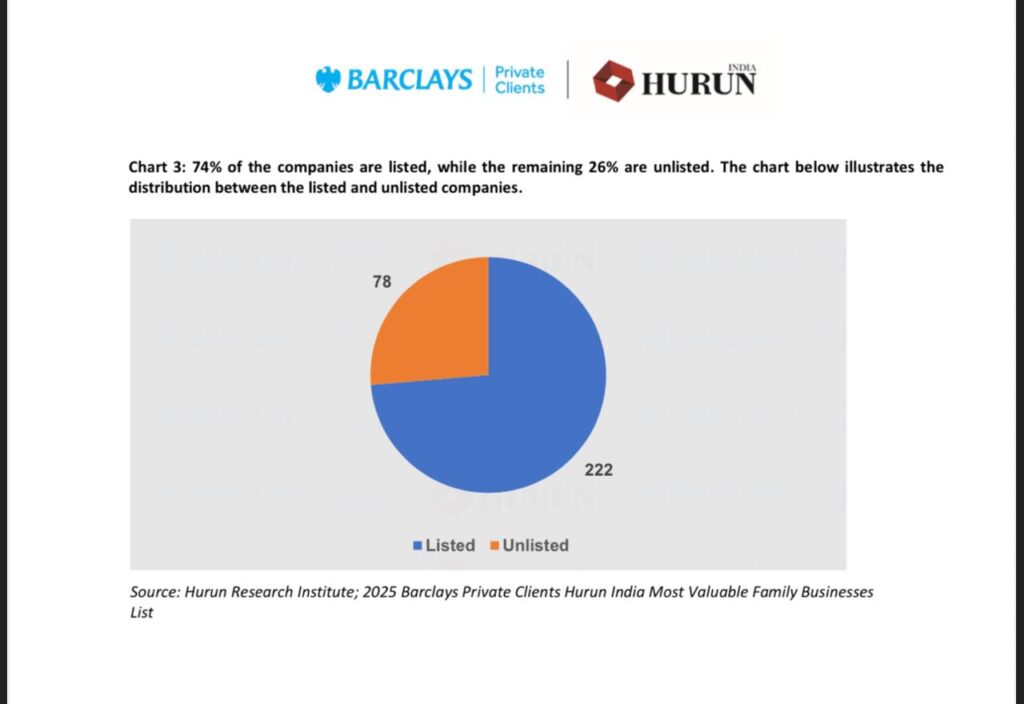
economic resilience. Notably, the majority of these enterprises are publicly listed (222 companies vs. 78 unlisted), reflecting greater transparency and institutional governance.”
“Roughly 120 families on the Barclays Private Clients Hurun India Family Business List 2025—spanning Arvind’s denim, Bharat Forge’s truck axles, and Meril’s medical devices—face billions of dollars in export revenue at risk over the next 12 months as U.S. tariffs climb to 50%. This is a once-in-a-generation stress test of resilience and agility. Yet if history is a guide—across wars, recessions and a pandemic—India’s multi-generation family enterprises are better poised than most to absorb the shock and adapt!”
India’s family-run firms are increasingly driving both capital deployment and social impact. Over 100 of these families also appear on the Hurun India Philanthropy List 2024, collectively donating close to INR 5,100 Cr last year – a testament to their commitment to nation-building beyond boardrooms. At the same time, they are investing heavily in the future: these families have backed more than 600 startups across sectors like fintech, clean tech, consumer brands, and more, bridging the gap between generational legacy and next-gen innovation. Such investments not only diversify their business interests but also demonstrate their belief in India’s new-age entrepreneurial ecosystem.”
“A hallmark of India’s top family businesses is successful multi-generational leadership. 76% of the most valuable family firms are now run by second-generation leaders (with the rest led by third generation or older). At the same time, we see rising professionalism – 62 of these companies are helmed by outside professional CEOs (nine more than last year). Notably, 22 family businesses on the list have women at the helm, up from 15 a year ago, reflecting a positive shift towards greater diversity in family business leadership.”
“India’s most valuable family businesses are experiencing a significant churn — a powerful signal of evolution, ambition, and renewed competitiveness. Compared to last year, there has been a 10% change in the Top 10, 32% in
the Top 50, and a striking 70% shift in the Top 200 threshold. The cumulative valuation of the Top 200 has surged by 15%, while the overall list has grown by 23% year-on-year. These aren’t just numbers — they reflect a rapid pace of value creation and transformation within legacy firms. What’s more, the regional footprint is expanding: 300 families now span 45 cities, while the Top 200 hail from 32 cities (up from 30 last year), showcasing the growing decentralisation of India’s entrepreneurial wealth.”
“These family enterprises are not just creating value but also providing livelihoods and strengthening the nation’s finances. The top 300 families on our list employ around 2 million people across India – roughly half the population of Lucknow – and contributed INR 1.8 lakh crore in taxes last year, accounting for about 15% of India’s corporate tax collections. In fact, India’s top three family business dynasties alone are now worth INR 40.4 lakh crore (up INR 4.6 lakh crore from last year) – nearly equivalent to the GDP of the Philippines. Such value creation, alongside massive job generation and tax payments, is accelerating India’s journey towards a USD 5 trillion economy, bolstered by initiatives such as Make in India, rising exports, and digitalisation-led growth.”
“From daily essentials to cultural celebrations, family-run businesses are woven into the fabric of Indian life. List features businesses from 45 cities across the country – with Mumbai alone home to 91 of them – proving that their impact reaches far beyond traditional corporate hubs. Many of the products we rely on every day come from these enterprises – whether it’s the “bhujia” served at weddings from Haldiram’s, life-saving medicines from Cipla, or the shop from The Phoenix Mills. It’s no surprise that about 40% of the companies on our list are consumer-facing brands,underlining their ubiquitous presence in households across India. This blend of heritage and forward-thinking by family brands has shaped not only our economy but also our daily habits and cultural moments.”, concluded Anas Rahman Junaid. concluded Anas Rahman Junaid.